Spiritual Reflection as a Mystery School Practice of Initiation
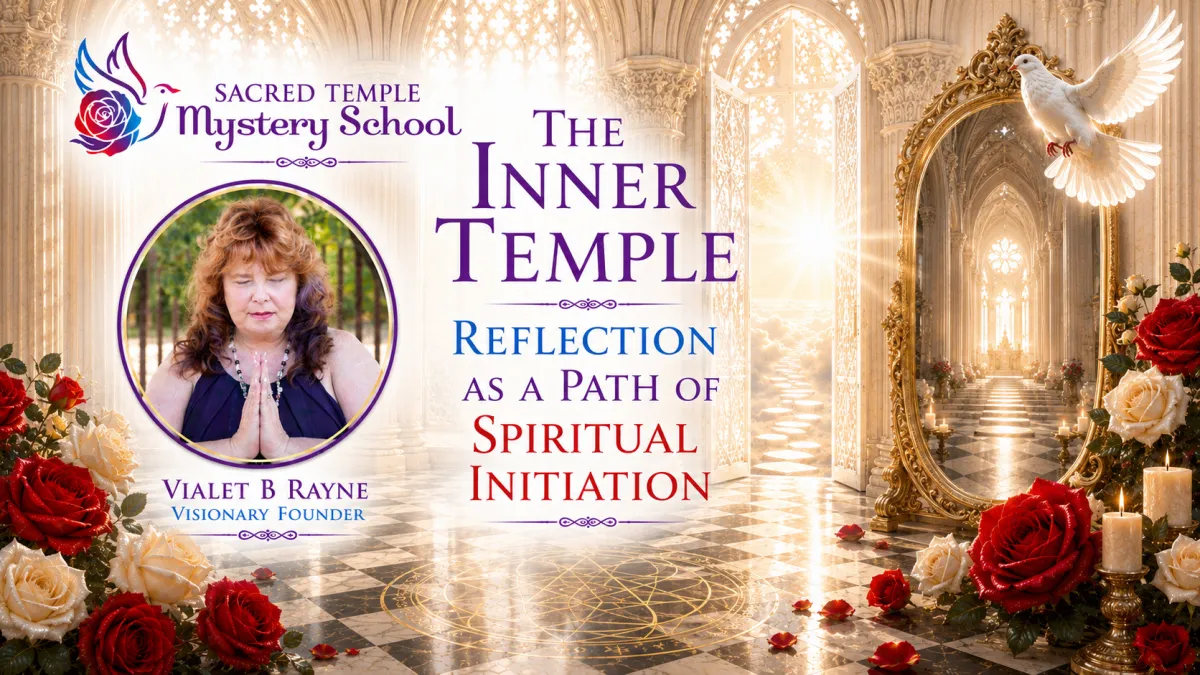
The Inner Temple: Reflection as a Path of Spiritual Initiation
The path of spiritual initiation requires more than receiving knowledge.
We can study ancient traditions, learn sacred symbols, participate in ceremonies, and develop spiritual gifts. However, knowledge alone does not transform us. Transformation occurs when a teaching moves beyond the intellect and becomes part of how we live.
Reflection creates the bridge between receiving a teaching and embodying its wisdom.
Without reflection, we may collect spiritual information without recognizing how it applies to our choices, relationships, patterns, and responsibilities. We can speak about spiritual principles while continuing to respond from fear, ego, habit, or unresolved pain.
The initiate must be willing to enter the inner temple.
This temple is not built from stone. It exists within consciousness. It is the sacred space where we meet ourselves without performance, distraction, or illusion.
Within the inner temple, we ask not only, “What have I learned?” but also, “How has this teaching changed me?”
The Difference Between Information and Wisdom
Spiritual information can be learned, remembered, organized, and repeated. Wisdom must be experienced.
You may understand the importance of boundaries intellectually but continue saying yes when your soul is asking you to say no. You may teach the value of trust while attempting to control every outcome. You may speak about Divine timing while becoming impatient when your plans do not unfold quickly.
This does not make you a failure. It reveals the place where a teaching has not yet been fully embodied.
Information becomes wisdom through practice, experience, reflection, and integration.
The initiate is not expected to achieve immediate perfection. Spiritual mastery is not the absence of human challenges. It is the willingness to meet those challenges with growing awareness.
Each experience becomes part of the teaching. Relationships reveal where our boundaries need attention. Conflict exposes unhealed wounds. Uncertainty shows us where trust remains conditional. Leadership reveals our relationship with power, service, responsibility, and recognition.
The spiritual classroom extends far beyond the temple walls.
Entering the Inner Temple
The outer temple provides sacred structure. It creates a space for ceremony, teaching, community, and connection with Divine Presence. The inner temple is where these experiences are integrated.
Entering the inner temple requires stillness. It asks us to step away from noise, outside opinions, responsibilities, and constant activity.
When the outer world becomes quiet, the inner world becomes easier to hear.
At first, we may encounter restlessness. Thoughts that were hidden beneath activity rise to the surface. Emotions we postponed begin asking for attention. Questions we avoided become more difficult to ignore.
This is not evidence that the practice is failing. It is evidence that the doorway has opened.
The inner temple does not reveal only peace and light. It also reveals the beliefs, fears, desires, and patterns that shape our lives from beneath conscious awareness.
The initiate enters this space with courage and compassion.
Reflection as a Sacred Mirror
A mirror does not create what it reflects. It reveals what is already present.
Sacred reflection becomes a mirror for the soul. It allows us to see where our actions align with our spiritual values and where they do not.
We may discover that our desire to serve contains an unacknowledged need for approval. Our commitment to helping others may conceal discomfort with receiving. Our pursuit of knowledge may protect us from the vulnerability of practice.
These realizations are not punishments. They are invitations into greater honesty.
The ego may resist this process because it prefers a fixed identity. It wants to be seen as wise, loving, capable, spiritual, or healed. The soul is less concerned with maintaining an image. It seeks truth, growth, and integration.
Sacred reflection asks us to release the need to appear spiritually accomplished. It gives us permission to become spiritually honest.
The Initiate and the Personality
The personality is the human self shaped by our experiences, roles, conditioning, preferences, fears, and desires. It helps us navigate the physical world and is an essential part of our incarnation.
The personality is not something that must be destroyed. It must be understood, healed, and brought into relationship with the soul.
The soul carries a larger perspective. It recognizes purpose, growth, service, and the deeper meaning within our experiences. Where the personality seeks comfort and certainty, the soul may choose expansion. Where the personality seeks recognition, the soul may call us into humble service.
Reflection helps us notice which aspect is directing our choices.
We might ask:
Is this decision aligned with my soul, or is my personality seeking approval?
Am I acting from sacred responsibility or from the need to control?
Am I serving because I am genuinely called, or because I am afraid of disappointing others?
Am I resisting this teaching because it is untrue, or because it challenges an identity I have outgrown?
The purpose of these questions is not to condemn the personality. It is to develop discernment.
Spiritual initiation invites the personality to become a conscious vessel for the soul.
Recognizing Spiritual Bypassing
Spiritual teachings can bring healing and liberation, but they can also be used to avoid uncomfortable human experiences.
We may speak of forgiveness before allowing ourselves to acknowledge anger. We may claim that everything happens for a reason while refusing to grieve a loss. We may focus on positive thinking while ignoring a situation that requires boundaries or practical action.
This is sometimes called spiritual bypassing: using spiritual concepts to avoid emotional healing, personal responsibility, or difficult truth.
Sacred reflection helps us recognize when this is happening.
Light does not require us to deny darkness. Love does not ask us to tolerate harmful behavior. Forgiveness does not remove the need for discernment. Trusting the Divine does not mean abandoning practical responsibility.
The initiate learns to bring spiritual wisdom into relationship with the full human experience.
We do not rise above our humanity. We bring consciousness into it.
Reflection After Ceremony
Ceremony can create powerful energetic and spiritual experiences. An individual may receive insight, healing, activation, or a profound sense of connection.
However, the ceremony is not complete when the candle is extinguished or the sacred space is closed.
Integration is part of the ceremony.
After a meaningful spiritual experience, take time to notice what has changed. Pay attention to your dreams, emotions, energy, relationships, and choices. A teaching may continue unfolding long after the formal ritual has ended.
Ask yourself:
What did I experience?
What did I understand?
What challenged me?
What is asking to be integrated?
What action will honor what I received?
Without integration, a ceremony may become a beautiful memory. Through reflection, it becomes a living initiation.
The Role of Discomfort
Initiation often brings discomfort because it disrupts what has become familiar.
A teaching may reveal that a long-held belief is no longer true. A ceremony may awaken a gift that requires responsibility. A leadership role may expose insecurity or fear of visibility.
The personality may interpret this discomfort as evidence that something is wrong. The soul may recognize it as the edge of expansion.
Not all discomfort should be pushed through. Discernment remains essential. There is a difference between the discomfort of growth and the warning of genuine harm or misalignment.
Reflection allows us to explore that difference.
When discomfort arises, ask what it is protecting. Notice whether it feels connected to an old wound, a healthy boundary, unfamiliar growth, or intuitive guidance.
The initiate does not blindly obey every fear or ignore every warning. They develop the wisdom to listen more deeply.
The Shadow Within the Temple
Every initiate encounters the shadow.
The shadow contains the qualities, emotions, desires, and experiences we have rejected or hidden. Some aspects were labeled unacceptable by family, religion, culture, or community. Others were buried because they did not fit the identity we wanted to maintain.
The shadow is not composed only of qualities we consider negative. It may also contain our confidence, power, creativity, sensuality, leadership, or spiritual gifts.
Sacred reflection brings light to these hidden places.
We may recognize jealousy beneath criticism, fear beneath control, or grief beneath anger. We may also discover a gift we have minimized because we were afraid of being seen.
The goal is not to eliminate the shadow. It is to bring unconscious material into conscious relationship.
What remains unconscious can direct our lives without our awareness. What becomes conscious can be healed, integrated, and transformed.
Reflection Within Sacred Community
Spiritual initiation is deeply personal, but it does not need to be solitary.
Sacred community provides mirrors that we cannot always provide for ourselves. Trusted teachers, mentors, and spiritual companions may recognize patterns, strengths, and blind spots that are difficult for us to see.
Community also reveals how we embody our teachings in relationship with others.
It is easy to feel peaceful when we are alone. The deeper practice is maintaining presence during disagreement. It is easy to believe we have strong boundaries until someone we love asks us to abandon them.
Sacred community asks us to practice honesty, respect, compassion, accountability, and service.
The purpose of spiritual community is not to ensure that everyone agrees. It is to create a space where individuals can grow without being diminished and receive truth without being shamed.
Reflection allows us to consider what our interactions within community are teaching us.
A Practice of Daily Review
A simple daily review can become a powerful Mystery School practice.
At the end of the day, sit quietly and review your experiences from morning to evening. Observe them as if you were watching scenes unfold before you.
Do not immediately judge or analyze. Notice where you felt present, aligned, reactive, guarded, loving, fearful, or empowered.
Then ask:
Where did I act from my spiritual truth?
Where did I respond from habit or fear?
What interaction carried a teaching?
What emotion needs to be acknowledged?
What am I grateful for?
What would I choose differently with greater awareness?
What wisdom will I carry into tomorrow?
Complete the review by releasing judgment and offering yourself compassion. The purpose is not to create a daily list of failures. It is to strengthen conscious awareness.
Close with the affirmation:
I receive the wisdom of this day. I honor where I acted with consciousness and bring compassion to the places still healing. May every experience guide me toward greater truth, service, and spiritual mastery.
A Ritual for Entering the Inner Temple
Create a quiet space and place a candle before you. The candle represents the light of consciousness.
You may also place a mirror on the altar. Let it represent your willingness to see yourself with honesty and compassion.
Light the candle and say:
I enter the inner temple with courage. I ask to see what serves my healing, growth, and spiritual evolution. May truth be revealed through the presence of Divine Love.
Gaze gently at the flame for several moments. Then close your eyes and imagine yourself standing before the entrance of a sacred temple.
When you are ready, enter.
Notice the temple’s shape, colors, symbols, and energy. At its center, imagine a sacred mirror. Stand before it and ask:
What am I ready to understand about myself?
Do not force an image or answer. Receive whatever arises through thought, feeling, sensation, or knowing.
When the experience feels complete, thank the wisdom of the inner temple. Imagine yourself leaving through the doorway and returning to your physical surroundings.
Record your experience in your journal.
Journal Prompts for Sacred Reflection
Which spiritual teaching am I being asked to embody more fully?
Where is there a difference between what I believe and how I live?
What role or identity am I trying to protect?
Where am I seeking recognition instead of practicing sacred service?
What emotion have I attempted to avoid through spiritual practice?
What is my discomfort trying to teach me?
Which aspect of my shadow is ready to be acknowledged?
What gift have I hidden because I feared being seen?
How do I respond when someone offers feedback or challenges my perspective?
What recent experience has served as an initiation?
What wisdom have I received but not yet integrated?
What action would demonstrate that I have embodied the lesson?
How can I bring greater consciousness into my relationships and community?
What does spiritual mastery mean to me now?
The Path of Embodied Wisdom
The true measure of spiritual study is not how much information we can remember. It is how fully we embody what we have received.
Does our knowledge make us more compassionate? Do our practices make us more present? Does our connection with the Divine deepen our integrity, responsibility, and capacity to serve?
Reflection keeps the spiritual path honest.
It reveals where we have grown and where our healing continues. It allows us to recognize when the personality has claimed ownership of a sacred role. It reminds us that every initiation carries the responsibility of integration.
Enter the inner temple regularly.
Sit before the sacred mirror without condemnation or illusion. Celebrate the light you have cultivated. Acknowledge the shadow still asking for love. Gather the wisdom contained within both.
Spiritual mastery is not a final state of perfection.
It is the continuing willingness to see, learn, heal, embody, and serve.