Why Mystery Schools Use Ritual, Ceremony & Sacred Practice
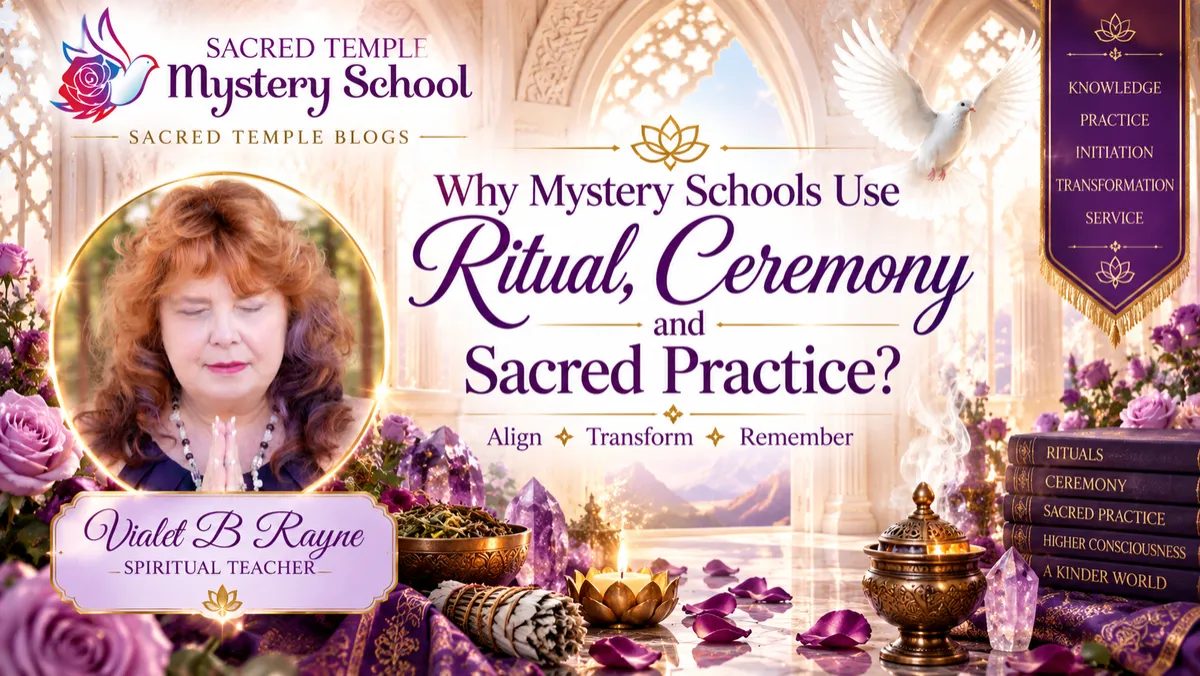
WHY MYSTERY SCHOOLS USE RITUAL, CEREMONY & SACRED PRACTICE
Why do Mystery Schools use ritual?
Why do we light candles?
Stand before altars?
Speak invocations?
Work with sacred tools?
Move through ceremony?
Repeat practices that have been performed many times before?
From the outside, ritual can sometimes appear to be a collection of symbolic actions.
But within a Mystery School, ritual is not simply about what you are doing.
It is about who you become while you are doing it.
Ritual asks you to become present.
Ceremony creates a threshold.
Sacred practice transforms spiritual knowledge into lived experience.
And that is one of the fundamental differences between simply learning about spirituality and walking an initiatory path.
INFORMATION IS NOT INITIATION
We live in an extraordinary time.
Almost any spiritual subject can be researched within seconds.
You can read about meditation.
Watch someone perform a ritual.
Study ancient spiritual traditions.
Learn Tarot.
Research angels.
Explore energy healing.
Read sacred texts.
Listen to teachers from around the world.
Access to information is not the challenge.
Integration is.
You can intellectually understand a spiritual concept without ever embodying it.
You can read about sacred space without knowing how to create it.
You can memorize an invocation without understanding what it feels like to speak sacred words with presence.
You can study the elements without developing a relationship with Earth, Air, Fire, and Water.
You can learn about spiritual service without ever serving.
Mystery School teachings are intended to move beyond information.
They invite experience.
RITUAL SLOWS US DOWN
One of the first gifts of ritual is surprisingly simple.
It makes us slow down.
Think about how quickly we move through an ordinary day.
We answer messages while eating.
We think about tomorrow while driving.
We listen to someone while planning what we will say next.
Our bodies may be in one place while our minds are somewhere completely different.
Ritual interrupts that pattern.
You stop.
You prepare.
You enter consciously.
You light the candle intentionally.
You take your place.
You breathe.
You listen.
You speak the words.
You notice what you are doing.
For a moment, you become fully present.
Presence is a spiritual practice.
SACRED SPACE CHANGES HOW WE SHOW UP
A Temple is not simply a classroom with spiritual decorations.
Sacred space is intentionally created.
When students enter the Temple, they are invited to shift their awareness.
They are leaving the ordinary rhythm of their day and stepping into a space dedicated to spiritual study and practice.
That transition matters.
The way we enter matters.
The way we move within the space matters.
The way we approach an altar matters.
The way we interact with sacred tools matters.
Not because the Divine will punish us if we do something incorrectly.
But because intentional actions teach us to become intentional people.
Eventually, the lesson extends beyond the Temple.
How do you enter someone's home?
How do you enter a conversation?
How do you enter a relationship?
How do you enter another person's sacred space?
Awareness begins to become a way of living.
CEREMONY CREATES A THRESHOLD
Ceremony is often used to recognize transition.
Human beings have always created ceremonies around important thresholds.
Birth.
Coming of age.
Marriage.
Death.
Initiation.
Graduation.
Seasonal changes.
Beginnings.
Endings.
A ceremony says:
Something is changing here. Pay attention.
Within Mystery School work, ceremony allows us to consciously acknowledge transformation.
There is a difference between thinking:
I am ready to release this.
And standing within sacred space, naming what you are releasing, taking a symbolic action, witnessing its completion, and consciously crossing into something new.
The ceremony does not magically do the inner work for you.
It marks your willingness to participate in that work.
WHY DO WE USE SYMBOLS?
The language of Mystery Schools has always included symbolism.
Candles.
Keys.
Doors.
Water.
Fire.
Trees.
Flowers.
Stars.
Swords.
Cups.
Circles.
Sacred geometry.
Colors.
Numbers.
These objects and images can hold layers of meaning.
A key can represent access, knowledge, responsibility, or initiation.
Fire can represent illumination, transformation, purification, passion, or Divine presence.
Water can symbolize emotion, intuition, cleansing, receptivity, and flow.
A doorway can represent transition.
A circle can represent unity, protection, wholeness, continuity, or sacred space.
Symbols invite us to move beyond literal thinking.
They ask:
What does this mean to you?
WHY WORK WITH AN ALTAR?
An altar creates a physical focal point for intention and sacred practice.
It can hold symbols of the Divine, the elements, spiritual beings, ancestors, sacred tools, candles, flowers, crystals, offerings, or objects connected with the work being performed.
But the altar itself is not the destination.
It teaches relationship.
How do you approach sacred space?
How do you care for it?
How do you prepare it?
How do you maintain it?
What happens within you when you stand before it?
Students may initially focus on where everything belongs.
Over time, they begin understanding that the external altar is also teaching them about the internal altar.
What are you devoted to?
What receives your attention?
What do you consider sacred?
What are you placing at the center of your life?
SACRED TOOLS REQUIRE CONSCIOUSNESS
A spiritual tool does not replace spiritual development.
You can own beautiful crystals and never become grounded.
You can own hundreds of Tarot decks and never develop discernment.
You can purchase elaborate ritual tools and never learn presence.
The tool supports the practice.
You bring the consciousness.
Within Mystery School training, sacred tools provide opportunities to develop intention, focus, awareness, symbolism, energetic sensitivity, and responsibility.
Students learn not only how to use a tool, but also why they are using it.
That distinction matters.
Without intention, we can easily begin performing actions automatically.
Sacred practice asks us to remain conscious.
THE POWER OF INVOCATION
An invocation is more than words written on a page.
When spoken consciously, it can become a declaration of intention.
You stand.
You breathe.
You become present.
You speak the words deliberately.
Your voice becomes part of the ritual.
This is one reason I believe practicing invocations is valuable.
Many people are uncomfortable hearing their own voice in sacred space.
They rush.
Speak quietly.
Become self-conscious.
Worry about making a mistake.
But spiritual leadership eventually requires us to become comfortable with our presence.
It asks us to stand.
Speak.
Hold space.
And mean what we say.
The practice is not simply memorizing words.
It is learning to bring your whole presence to those words.
REPETITION IS PART OF THE TEACHING
Why repeat rituals?
Because you are not the same person each time you perform them.
A ritual performed when you are beginning your journey may feel completely different after months or years of spiritual practice.
The words may be identical.
The altar may look the same.
The movements may not have changed.
But you have.
Repetition allows you to experience your own growth.
The first time, you may be focused on remembering what comes next.
Later, you begin understanding the symbolism.
Eventually, the practice becomes more natural and you can become present with the deeper experience.
Repetition moves us from remembering the steps toward embodying the practice.
RITUAL WITHOUT PRESENCE BECOMES PERFORMANCE
There is also a caution within ritual work.
It is possible to perform every step correctly and still be completely disconnected from what you are doing.
You can light the candle while thinking about your grocery list.
You can say the invocation without listening to the words.
You can move through a ceremony simply because you know the sequence.
At that point, ritual becomes performance.
Sacred practice asks something more.
Be here.
Know why you are doing what you are doing.
Feel the words.
Understand the intention.
Allow yourself to participate fully.
The goal is not perfection.
The goal is presence.
THERE IS NO PRIZE FOR BEING THE MOST SPIRITUAL PERSON IN THE ROOM
Mystery School work can introduce students to beautiful teachings, sacred practices, ancient traditions, energetic experiences, and spiritual tools.
But none of those things should become evidence that we are better than another person.
Spiritual knowledge carries responsibility.
The deeper we travel, the more important humility becomes.
There will always be something we do not know.
There will always be another interpretation.
Another tradition.
Another perspective.
Another mystery.
The moment we believe we have mastered everything is often the moment we stop learning.
Approach sacred teachings with confidence, but also with humility.
CEREMONY DOES NOT REPLACE PERSONAL RESPONSBILITY
A ritual can support healing.
A ceremony can mark release.
An initiation can recognize transformation.
But none of these things replace the choices we make afterward.
You can perform a beautiful releasing ceremony and pick the same burden back up tomorrow.
You can participate in an initiation and refuse to integrate what you learned.
You can stand before an altar and make a commitment that you never honor outside the Temple.
The true measure of sacred practice is not what happens during the ceremony.
It is what happens afterward.
How do you live?
How do you speak?
How do you treat people?
How do you handle conflict?
How do you maintain your boundaries?
How do you use your spiritual gifts?
How do you serve?
That is where spiritual teachings become embodied.
RITUAL CREATES SACRED MEMORY
There are moments from ceremony that remain with us.
A candle being lit.
A flower being received.
A particular invocation.
A moment of silence.
Standing beside people who have walked the journey with us.
Crossing a threshold.
Receiving a sacred object.
Completing an initiation.
These experiences become markers along our spiritual path.
Years later, we may not remember every page of a class book.
But we remember how the ceremony felt.
We remember what we realized.
We remember who we were when we entered.
And we remember who we were becoming when we left.
That is the power of sacred memory.
EVENTUALLY, YOUR LIFE BECOMES THE PRACTICE
This may be the deeper purpose behind everything we practice within the Temple.
Eventually, you leave.
You go home.
You return to your family.
Your work.
Your responsibilities.
Your relationships.
Your ordinary life.
And that is where the real practice begins.
Can you bring the same presence to a difficult conversation that you bring to an invocation?
Can you create sacredness around your morning cup of tea?
Can you recognize when your energy needs clearing?
Can you pause before reacting?
Can you honor another person's boundaries?
Can you speak with intention?
Can you serve without needing recognition?
Can you treat the person standing in front of you as sacred?
Eventually, there is less separation between spiritual practice and daily life.
Your life becomes the Temple.
WHY MYSTERY SCHOOLS USE RITUAL AND CEREMONY
Mystery Schools use ritual, ceremony, and sacred practice because spiritual teachings are meant to be experienced.
Ritual teaches presence.
Ceremony recognizes transformation.
Symbols invite deeper contemplation.
Altars teach devotion and intention.
Sacred tools develop awareness.
Invocation develops voice and presence.
Repetition creates embodiment.
Service carries the teachings beyond ourselves.
And sacred practice reminds us that spirituality is not something we simply study.
It is something we live.
The greatest ritual may not be the one performed before an elaborate altar.
It may be how consciously you enter your day.
The greatest invocation may not be the one spoken inside the Temple.
It may be the words you choose when someone needs kindness.
The greatest act of spiritual service may never be witnessed by anyone else.
And perhaps the greatest initiation occurs when you realize:
You were never being taught only how to practice inside sacred space.
You were learning how to become sacred space wherever you go.
5